
Inside the Raptor engine.
Follow the methane and the oxygen from the tanks to the flame. Simple first, nerd detail when you want it.
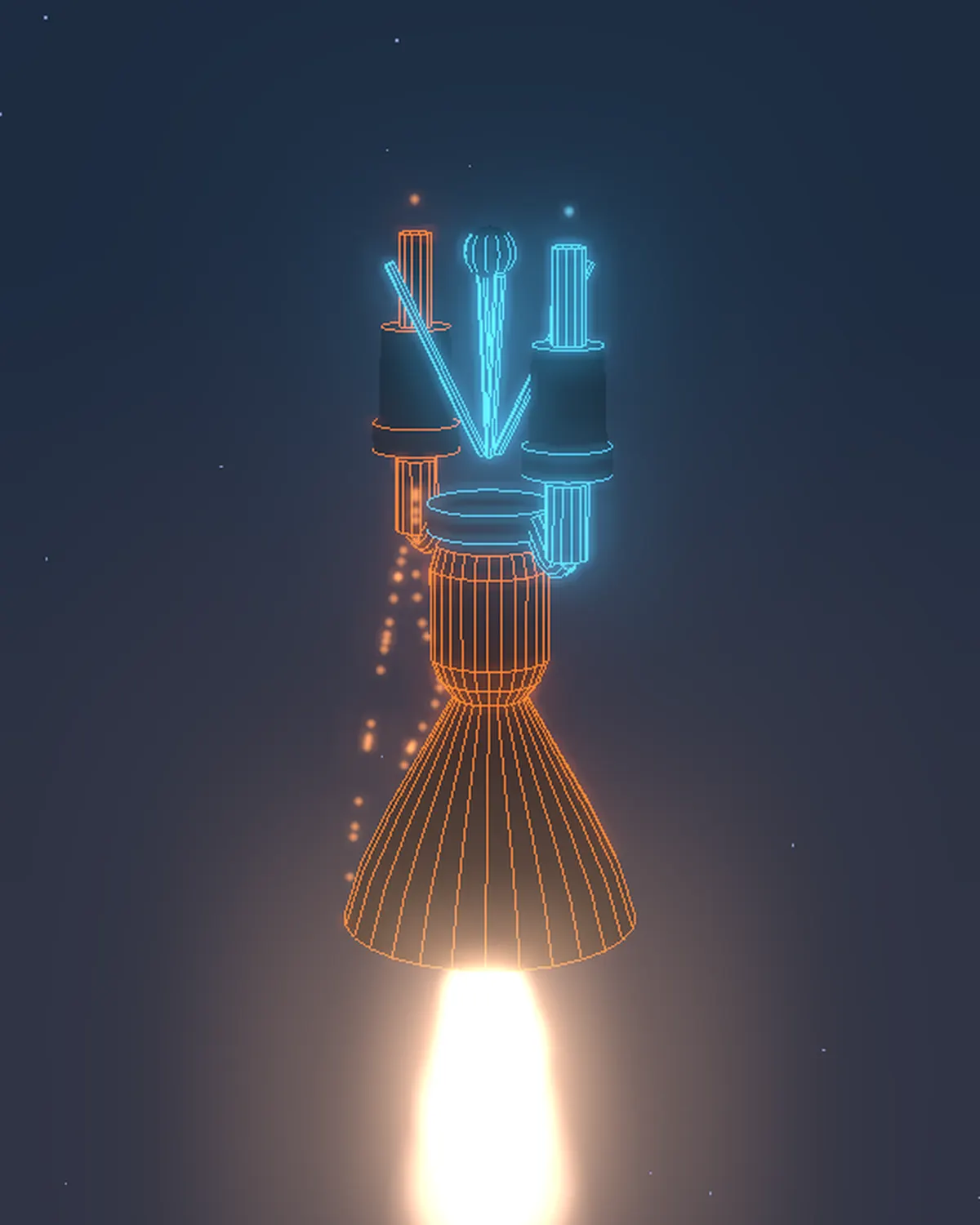
Eight steps, tank to flame.
- 01 · Overview
Raptor, the engine
Raptor is the engine that powers both halves of Starship. It burns liquid methane with liquid oxygen. About the size of a small car standing on end.
Watch: How much thrust does the booster make? ↗Tap for nerd detail
SpaceX says the latest version, Raptor 3, makes 250 tonnes-force of thrust at sea level (551,000 lbf), up from 230, and weighs 1,525 kg, down from 1,630. Sensors and controllers now sit inside the engine's own heat protection, so the bulky shrouds are gone. The model here is schematic, simplified from public photos.
- 02 · Methane + LOX
Methane and liquid oxygen
Two super-cold liquids come in at the top: methane is the fuel, oxygen lets it burn. Blue dots are oxygen, orange dots are methane.
Watch: How much fuel does it take to fill Starship? ↗Tap for nerd detail
Both are stored as cryogenic liquids, chilled even below their normal boiling points so more fits in the tanks. Methane burns fairly cleanly, leaves less soot inside the engine than kerosene, which matters for reuse, and can in principle be made on Mars from carbon dioxide and water. The booster carries about 3,650 tonnes of propellant, the ship about 1,600.
- 03 · Turbopumps
Two turbopumps
Each liquid gets its own pump, spun by its own little turbine. They shove the propellant into the engine at enormous pressure.
Tap for nerd detail
Raptor has one turbopump for oxygen and one for methane. Splitting them means each pump and turbine can run at its own best speed, and the two propellants never share a seal inside a single pump, a common failure point in older designs. Drag the Explode slider to pull the parts apart.
- 04 · Full-flow
The trick: full-flow staged combustion
Small burners light a little of the propellant to spin the turbines. Then all of that hot gas goes into the main chamber too. Nothing is thrown away.
Tap for nerd detail
One preburner runs rich in methane and drives the methane pump. The other runs rich in oxygen and drives the oxygen pump. Every drop of both propellants passes through a turbine and then into the main combustion chamber, which is why it's called full-flow. Only a few engines of this type were ever built and tested before Raptor, and Raptor is the first to fly. SpaceX has quoted chamber pressures around 300 bar for its design.
- 05 · Combustion
The main combustion chamber
Hot methane-rich gas meets hot oxygen-rich gas and burns. Because both arrive already as gas, they mix fast and burn evenly.
Tap for nerd detail
The injector at the top of the chamber meets the two hot gas streams. Gas-gas combustion mixes better than spraying in liquids, which helps efficiency and stability. Very high chamber pressure lets a fairly compact engine make enormous thrust.
- 06 · Regen
Cooling: methane in the walls
The flame is hotter than the metal can survive. So cold methane runs through tiny channels in the walls first, keeping them alive.
Watch: Why did Booster 22's flame turn green? ↗Tap for nerd detail
This is regenerative cooling: the fuel soaks up heat on its way to the preburner. It only works while there is enough fuel flowing. On Flight 15, the early explanation was that the booster came back low on fuel, the cooling circuit ran short, and copper inside the engines started burning, which is why the flame turned green. SpaceX says the root cause is still under investigation.
- 07 · Bell
The nozzle: sea level and vacuum
The bell shapes the exhaust into thrust. Engines that fire in space get a much bigger bell, shown here as the ghost outline.
Watch: Starship, explained ↗Tap for nerd detail
In thin air or vacuum, a bigger bell lets the gas expand further and push harder. SpaceX's vacuum Raptor 3 makes 275 tonnes-force. Starship's upper stage carries three sea-level engines, which can steer, and three vacuum engines, which can't. The ghost outline here is drawn for comparison; its exact proportions are approximate.
- 08 · Booster
Thirty-three of them
Look up from under the booster: 33 Raptors. The 13 in the middle can swivel to steer; the outer 20 are fixed.
Watch: How much thrust does the booster make? ↗Tap for nerd detail
At 250 tonnes-force each, 33 engines add up to roughly 8,250 tonnes-force at full power (our multiplication, not a SpaceX figure). In V3, SpaceX redesigned the tube that feeds them fuel, now roughly the size of a Falcon 9 first stage, so all 33 can start at the same time. The 3-10-20 ring layout here is schematic.
Schematic, simplified from public photos and SpaceX papers: real plumbing is far more complex, and the flow paths are illustrations. Thrust and mass figures are SpaceX's published Raptor 3 numbers. Sources: SpaceX, Introducing Starship V3 (May 12, 2026); SpaceX IAC 2016 paper; Smithsonian Air & Space.